
- Medical education and workforce development
- AMA Roundtable Discussions: Building a bridge beyond affirmative action
- Reimagining Medical Education: The future of health equity
- Excellence in Medical Education Grants
- Statement on improving health through DEI
- Affirmative action in medical education
- MedEd's horizon
- Resident Leadership Development Program
Medical education and workforce development
The primary role of medical education is to produce a competent health care workforce capable of meeting the health care needs of our population. Therefore, the central goal of our health care workforce must be the elimination of health care imbalances.
The health care workforce as historically and conventionally conceived has not accomplished this goal, and in many ways, has contributed to and compounded the problems. The effort to develop a workforce capable of addressing health care imbalances will produce a number of outcomes. An improved demographic mix and sense of belonging for members of the health care workforce will be among the most notable. This is the perspective that informs the work to which our team is dedicated. Specific examples are outlined below.
AMA Roundtable Discussions: Building a bridge beyond affirmative action to a diverse and equitable landscape in education and health care
In 2023, the AMA gathered thought leaders from across the medical education continuum to discuss the role of organized medicine in supporting medical education to optimize health outcomes across all communities. Over the course of a year, this community of thought leaders participated in roundtable discussions to develop recommendations for the organizations that provide medical education oversight to support our mission. This publication (PDF) outlines the recommendations and strategies that were developed to continue to drive the transformation of medical education and health care for the benefit of all.
Reimagining Medical Education: The Future of Health Equity and Social Justice
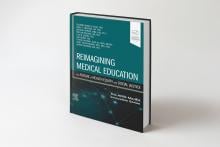
As part of the American Medical Association Innovation in Medical Education Series with Elsevier, Reimagining Medical Education: The Future of Health Equity and Social Justice has been published.
The externally commissioned publication is in response to a 2021 report by the AMA Council on Medical Education and imagines how to achieve equal opportunity and fair treatment for all backgrounds through medical education; improve the responsiveness and preparedness of the health workforce; and ameliorate unbalanced outcomes among all patient populations.
Watch on-demand webinar. David Henderson, MD, the AMA vice president of workforce development for medical education, moderated a discussion on the development and potential impact of the publication. Other participants in the conversation included Joaquin Baca, the AMA’s former director of workforce development for medical education, and two of the book’s editors—William McDade, MD, former chief diversity, equity, and inclusion officer at the Accreditation Council for Graduate Medical Education, and Janet Southerland, DDS, MPH, PhD, vice chancellor academic affairs and chief academic officer at Louisiana State University Health Sciences Center.
Excellence in Medical Education Grants
The recipients of the 2024 AMA Excellence in Medical Education Grants represented leading medical schools from across the country and were comprised of both single institutions and teams of institutions that worked collaboratively on their projects over two years.
The proposals selected for funding explored the priorities of innovation in admissions practices and assessment strategies in a post-affirmative action environment. Collectively these projects helped drive positive change across the medical education continuum—from premed to graduate medical education—and augment the AMA’s support of learning environments with students from a range of backgrounds to accelerate progress toward educational excellence and fairness for the communities we serve. The grant recipients joined the ChangeMedEd® Consortium and contributed to the AMA’s work to catalyze change and seek innovations that reduce barriers to lifelong learning, advance fairness and improve patient outcomes.
Statement on improving health through DEI
Leading health care and medical associations from across the country made a statement in support of DEI policies in health care, as a means to help improve the health of our nation.
Affirmative action in medical education
In 2023 the U.S. Supreme Court announced a ruling that restricts medical schools from considering race and ethnicity among the multiple factors in admissions policies.
The AMA adopted a policy on race-conscious admissions in higher education and has produced several resources and commentaries on affirmative action in medical education. The following is a selection of materials related to the ruling and demographic mix in medical education.
Policy
Press release
AMA news
- High court sets back efforts to diversify medicine, improve care
- AMA adopts policy for race-conscious admissions in higher education
- AMA: Don’t back down on diversity in medicine
Videos
- April 26, 2024: Navigating the Horizons: Understanding the Impact of DEI Legislation on Medical Training – National Medical Association webinar
- Affirmative action in medical education: Unpacking the Supreme Court Decision
- View and earn CME credit: Affirmative Action in Med Ed: Exploring the Consequences of an Adverse Supreme Court Decision
- AMA Update: Affirmative action ends: How Supreme Court ruling impacts medical schools & the health care workforce
MedEd's horizon
MedEd’s horizon: Just, merciful, diverse and equitable is a compendium of abstracts submitted to the AMA externally commissioned publication, Reimagining Medical Education: The Future of Health Equity and Social Justice. This publication is available for download from the AMA website at no cost (registration required).
These abstracts focus on reimagining the future of fairness in medical education; improving the responsiveness and preparedness of the health workforce; and ameliorating unbalanced outcomes among all patient populations. Over 150 groups of authors responded to the call for submissions.
Resident Leadership Development Program
Administered by the University of Cincinnati College of Medicine with support from the AMA, the Resident Leadership Development Program (RLDP) is a cohort-based leadership program for residents from backgrounds with limited representation in medicine. The program engages residents in a leadership curriculum, provides the opportunity for the participants to meet and engage with leaders in academic medicine with similar backgrounds, and helps them lead projects at their home institutions.
Current participants are in residency programs at the University of Cincinnati College of Medicine, Indiana University School of Medicine, Ohio State University College of Medicine and Virginia Commonwealth University School of Medicine.